
Which shared custody models are supported?
Under Custody planner › Shared custody models the app shows the seven most common custody arrangements, each with pros and cons, a live preview as a daily grid and a hint as to whether it can be set directly as a distribution pattern. Five of them you can save as a pattern for your plan in one step.
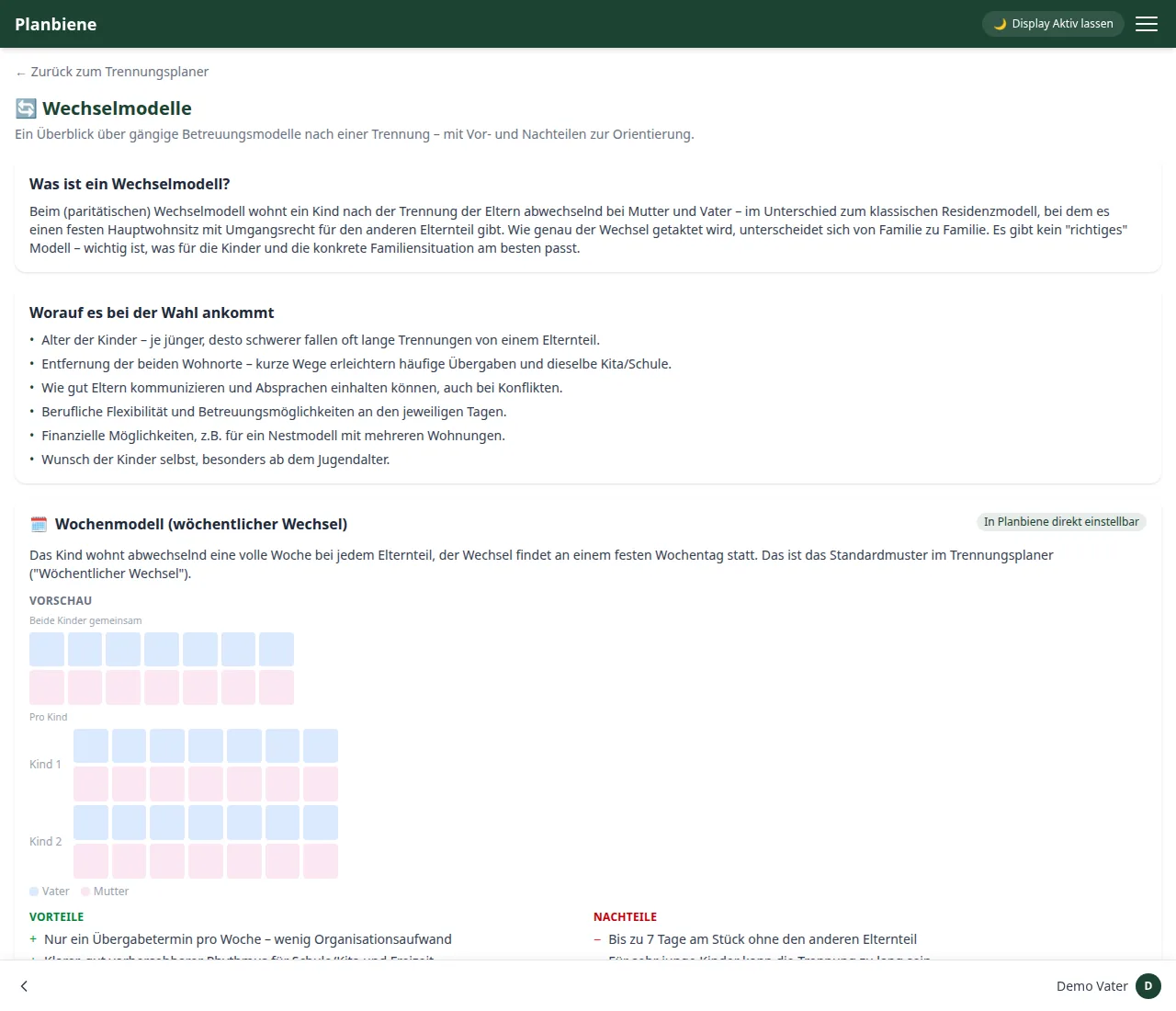
The five patterns you can set directly
- Weekly model – a weekly swap, always on Tuesdays for example. Easy to remember, clearly predictable.
- 2-2-3 model – two days, two days, three days, swapped in the following week. Short blocks, frequent contact with both parents.
- 2-2-5-5 model – two, two, five, five days. Medium-length blocks, with the parents taking turns spending longer with the children.
- 3-4-4-3 model – a 14-day cycle with an exact 50/50 split. Symmetrical and fair, but it takes a good memory for the changeover days.
- Exclusive 50/50 – a special pattern for exactly two children: a 4-week rhythm in which each child is in turn exclusively with one parent. Only selectable if you have exactly two children.
Two more that can be mapped well
- Nest model – it is not the child who moves, but the parents: the child stays in the home, the parents take turns being there. Not stored as a pattern of its own, but can be mapped with changeover days in the custody planner.
- Residence model with extended visitation – one parent has the main residence, the other has regular visitation (every weekend, for example). Almost always fits the calendar via a base pattern plus individual swap days.
Step by step: setting a pattern
- Open the Custody planner.
- Click Edit plan.
- Choose the desired model in the distribution pattern field.
- Set a start date and the parent the child is with on the start day.
- Click Save.
From now on the app calculates the calendar according to the pattern. Individual deviations – a special day, an extra visit – are swapped afterwards in the calendar via a swap day, without touching the pattern.
What matters when choosing
The most important factors: the children's ages, the distance between the homes, the parents' ability to communicate, professional flexibility, financial situation and the child's own wishes. Which model fits your situation is described in detail in the Handbook: Shared custody models.